



Resets the attention
A two-minute intervention every quarter of an hour keeps the room awake. It is not decoration: it is the only reliable way to sustain a long presentation.



Product Launches
An interactive presentation is one in which attendees take part through polls, questions or games, often from their mobile phones, instead of just listening.
Presentations where the audience votes, plays and answers from their phones instead of listening for forty minutes straight.
We run interactive presentations: live voting from phones, multiplayer quizzes with rankings, screens that react to the audience and dynamics that turn a talk into a conversation.
There is an uncomfortable fact anyone who has presented knows: a room's attention drops noticeably after the first quarter of an hour. It does not depend on how good the content is or how good a speaker is talking; it depends on listening without doing anything being a passive activity from which the brain disconnects. The only reliable way to reverse it is to ask the audience for something.
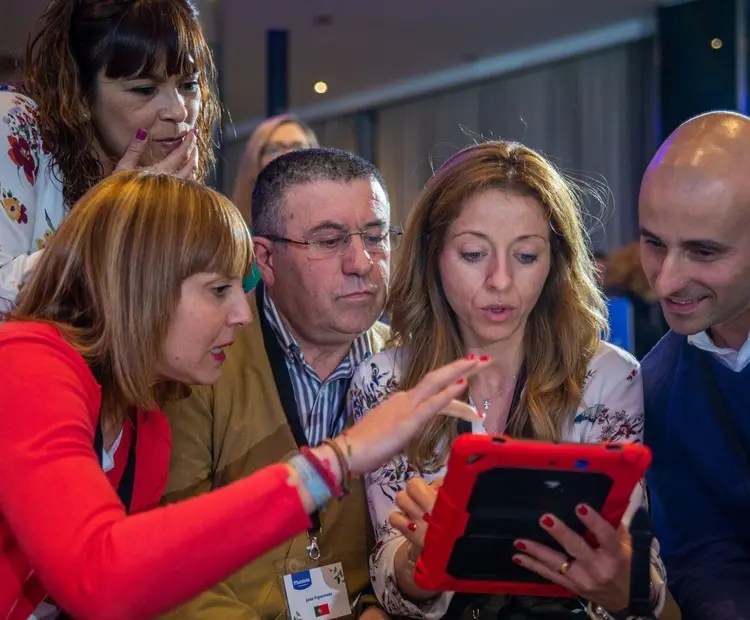
What works best is participation from phones, because everyone has one in hand and it needs no extra equipment. Live voting on a relevant question, a three-question quiz with a ranking, a word cloud built from the room's answers. They are two-minute interventions that reset attention and also generate content for the presentation itself.
The second tool is competition. A team quiz with a visible scoreboard turns an informative session into something people follow. It works particularly well in internal training, in product presentations to sales networks and at conventions, where it also uses the teams that already exist by office or unit.
We provide the technology, the content and the operator running the session in real time. That matters: live voting that fails or is slow to show results breaks the presentation's rhythm, so we work with our own system, our own connectivity where the venue is unreliable, and a full test before starting.
A two-minute intervention every quarter of an hour keeps the room awake. It is not decoration: it is the only reliable way to sustain a long presentation.
Everyone has their phone. Voting, quizzes and word clouds work without handing anything out and without explaining how to use them.
Voting that fails breaks the event's rhythm. We bring our own system, our own network where the venue is unreliable, and a full test before starting.
Duration, blocks and at which moments an intervention fits without breaking the thread.
Questions, mechanic, result format and how it integrates with your slides.
Content, connectivity and a full test in the room before the audience comes in.
A technician runs the session, launches each intervention at its moment and hands you the results at the end.
Not all breaks are worth the same. The first intervention should come early, around minute ten, because it establishes that the session is participative and people keep their phone to hand instead of putting it away. If the first arrives at forty minutes, half the room has already disconnected and recovering it is far harder.
The second critical window is immediately after lunch on a long day. And the last, near the end, works better as a close than as a question: a concluding survey or a final ranking leaves the feeling that the session had an arc, rather than simply ending when the slides run out.
No. Access is through the phone browser with a short code or a projected QR. It is deliberate: any extra step halves participation, and in a room of two hundred that shows.
We bring our own connectivity. It is one reason we insist on testing beforehand: coverage in a full room is not the same as in an empty one, and it is worth checking.
Yes. Interventions are launched from our system and projected on the same screen, alternating with your presentation. We rehearse it so the switch is clean.
Yes. We hand over answers, percentages and scores at the end. In internal training and at conventions it is usually useful information beyond the event itself.
Yes, though the format changes. Under thirty people anonymous voting loses its point and team quizzes work better, where the result is visible and there is real competition.